
A DAY AT THE RACES!
Going behind the scenes of Hong Kong's exciting racing circuit...

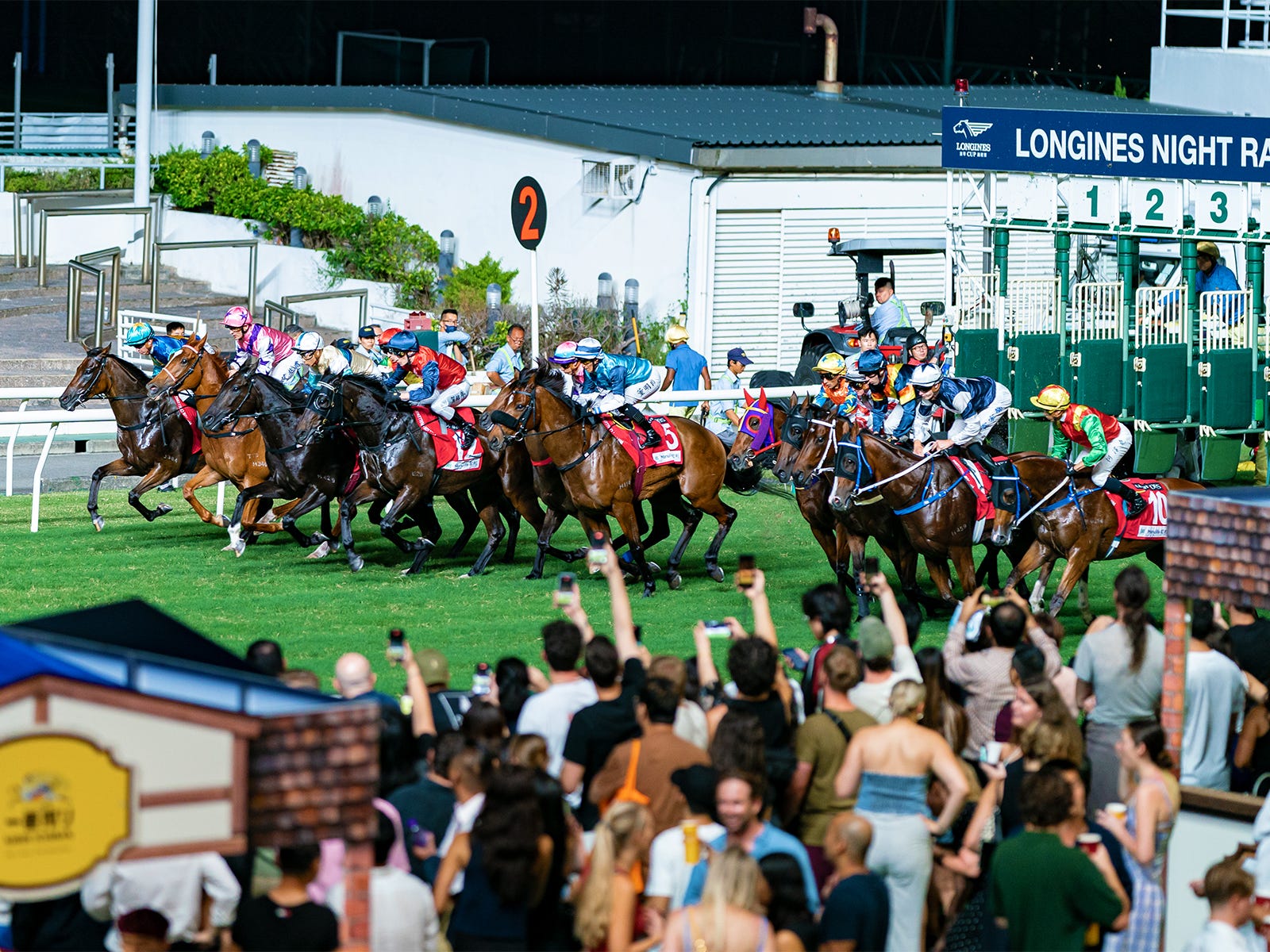
When 25 year old jockey Way Leung gets the call to ride in the Cathay Pacific Hong Kong International Races, it will be the culmination of nine years of intense training: six years as a jockey and 53 trips to the winner’s circle. But when he gets his horse in the starting gate, he has only one thing on his mind, and that’s position.
“I follow the advice of my trainer to get that good position,” he says. “Position is everything. When you race at Happy Valley, the first two hundred meters are critical. At Sha Tin, it’s the home stretch that really matters.” And once those gates open, any nervousness he may feel simply drifts away. “If you have more experience, you can feel how the horse is doing,” he says. “It takes a while. When I started I couldn’t tell. Now I can tell if the horse feels powerful and is concentrating. I just feel it.”
There are no guarantees for any of the jockeys who race in one of the world’s best horse-racing fraternities. But according to jockey lore, getting a good position at Happy Valley can almost guarantee a win, even on a horse that’s less than world-class. At Sha Tin though, it often comes down to skill, how the horse is feeling that day and sometimes, good old fashioned luck. That’s why Leung has the following maxim for would-be betters: “Don’t put big money on a horse because anything can happen in a race. Just bet small money. No horse is a sure thing,” he stresses.
(For a glimpse of the racing excitement in Hong Kong, look no further than this prestigious race at Shatin in 2023. By the time he retired in 2024, three-time horse of the year Golden Sixty had won 26 races, the most ever for a horse in the city, in addition to winning the most prize money in the world.)
The Hong Kong Jockey Club usually offers two race days for spectators. Wednesday evenings are typically reserved for racing at Happy Valley, while weekend races (usually held on Sundays) take place at the Sha Tin Racecourse in the New Territories (an easy 45 minute subway ride from Central). Both venues have sophisticated and up-to-date betting facilities, several high-end restaurants, fast-food outlets and even private boxes that can be reserved. While spectators may gleefully show up to cheer on hopeful winners around the track, it’s often a 24/7 commitment for those involved with some of the greatest racing on the planet.
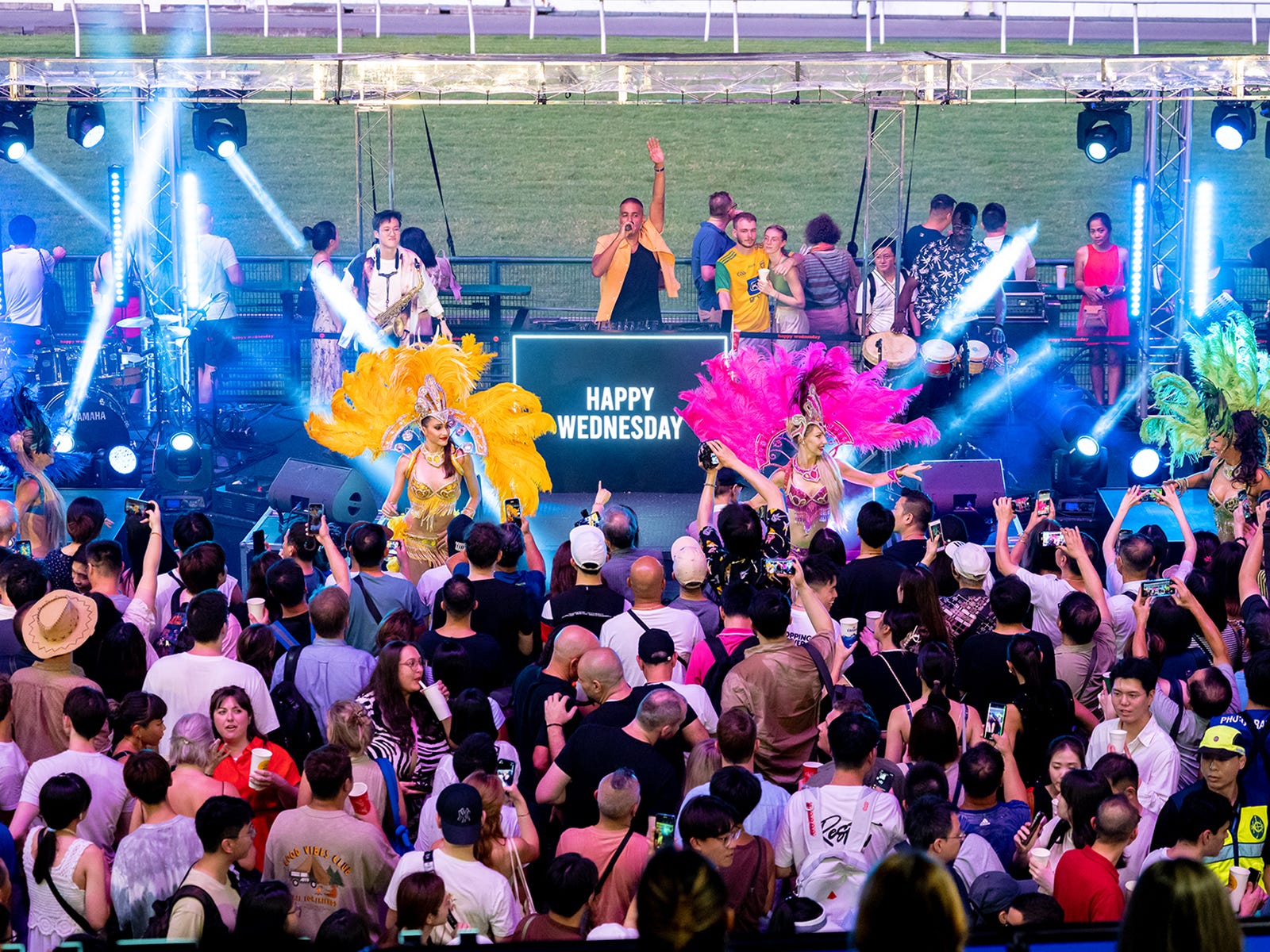
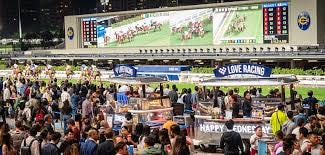
(Over the past two decades, Wednesday race nights at Happy Valley are much more than horses and jockeys. Food, DJs, live music, and themed attractions attract locals and tourists alike.)
A private visit to Sha Tin Racecourse reveals that horse racing in Hong Kong is by no means to be taken lightly. Its 25 stables house more than 1,000 race horses, ranging from two-to-10 years old, mostly from Australia and New Zealand. It’s common to see trainers and jockeys living in apartments on the grounds. A team of surgeons are also there to take care of the slightest medical injury at the on-site equine hospital. And every day at the break of dawn, horses are being trained. Jockeys are bettering themselves. Trainers are also watching to see how everyone is performing. It’s serious stuff.
That quickly became apparent when I visited well before dawn on a race day. Dozens of horses and their trainers take turns practicing on what is known as a slow track. They slowly canter their horses to see how they are performing. Everywhere, there are work riders, assistant trainers, jockeys and, of course, horses. It’s exciting, yet aside from the breath of the horses and the pounding of their hooves on the dirt, also eerily quiet.
Leung claims he can tell how a horse might perform in a race by their behavior during sessions like this. “Look carefully at the color,” he advises. “If the color is sharp they might do well. If they are sweating, it could mean they are anxious or nervous. Although…sometimes this works well for the horses.”
The more you watch the training, the more intricate it seems to become. Colored caps indicate what stable a horse is from, and the saddle cloths show what year the horses were imported to Hong Kong. Red, for example, means they’ve been here for one year. Horses are usually male, as they are the most competitive, and there is no breeding on the grounds. Trainers come from all over the world. For example, champion trainer John Size, often the most successful trainer in terms of wins, is from Australia. It’s a sport. It’s a passion. It’s big business.
(Click below to see trainer Tony Cruz provide a behind-the-scenes look at stable in life in Shatin).
Tony Cruz behind the scenes...
Leung’s entry into all of this, typical of most local jockeys, started when he was just 16 years old. His father, a mafoo at Happy Valley, urged him to become a jockey because he was short. But at the time he didn’t have an interest in horses. Nonetheless, he enrolled at a training school in Sheung Shui (far North of Hong Kong and close to the border), where the competition was fierce. 100 potential future jockeys get an interview. In the end, only eight will finish the 18-month course. Would-be riders must live on the grounds, rarely get holidays, and have a punishing schedule that begins at 5:30am and ends well into the evening. “I felt terrible when I first got on a horse because I couldn’t control it,” Leung says. “It’s funny if you haven’t been on one before. But once you are, you can understand their actions.”
Years later, after passing a barrier trial test, getting assigned to a trainer and several seasons of racing under his belt, Leung can look back at his hardships with some laughter. Yet as a jockey, he still has a lot to think about. There’s his weight, for starters. If he is scheduled to race in a lighter heat, he must watch his diet a couple days before a race. “Some jockeys end up going to the sauna so that they can make weight,” he says. Otherwise, Leung usually knows bright and early on Monday morning what horse or horses he’ll be riding on Wednesday. Then, it’s a matter of discussing tactics with his trainer, practice trials with the horse in question, and a final gallop on Wednesday morning to assess a horse’s chances.
As Leung well knows, a horse’s fitness isn’t something to over- or underestimate.
He claims racing is mostly safe because stewards enforce strict rules. However, there’s no way of knowing whether or horse may fall back because it’s tired, or if something else altogether is happening. “I’ve fallen off,” says Leung. “It didn’t hurt but sometimes you don’t know if a horse has heart disease or injured its leg. Once, one of my horses had a heart attack at Happy Valley. I was on the home stretch, 200 meters from the finish line. When that happens, you just have to protect yourself.”
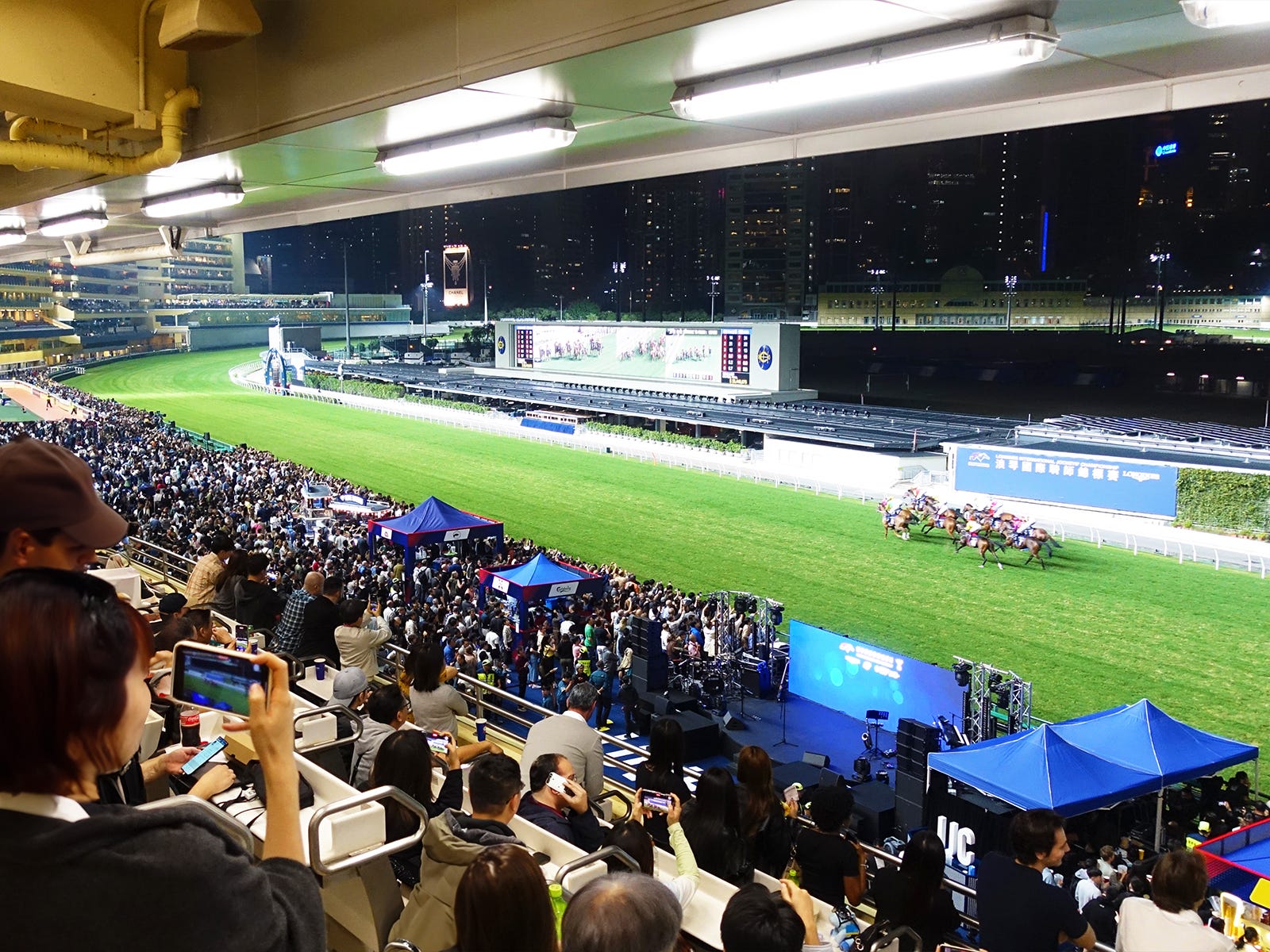
(As spectators look on in the stands, horses and their jockeys race towards the finish line during an evening race at Happy Valley.)
Fortunately, most of the time, Leung just concentrates on making it to the winner’s circle. When he does, it means a picture with the owner, nine percent of the total purse, and a trip back to the stables to get ready for the next race. “Price money is the incentive,” he says with excitement. And when the day is over, Leung leaves feeding duties to the trainers, but often assists in icing the horse’s legs, a process they often don’t like. “When they are shaking their heads back and forth or kicking their legs, they’re definitely not happy. It’s when they are silent and quiet that you know they’re fine.”
It’s all part of a jockey’s day, and indeed, a career. Leung aspires to be a jockey well into his 40s, just like his idol Michael Kinane, who he admires for his complete fitness. Meanwhile, it’s pre-dawn training sessions, meetings with trainers, occasional butterflies at the starting gate, and the hope of a lot more winners to come. And just to show that even jockeys often don’t know what horses will eventually win, Leung advised against betting on his three mounts later that night at Happy Valley. One of them ended up coming in first, at odds of 80 to 1! And it’s anecdotes like that which explain why so many punters turn up for the races at Happy Valley and Shatin: because you never know what’s going to happen next.
TRACK BREAK
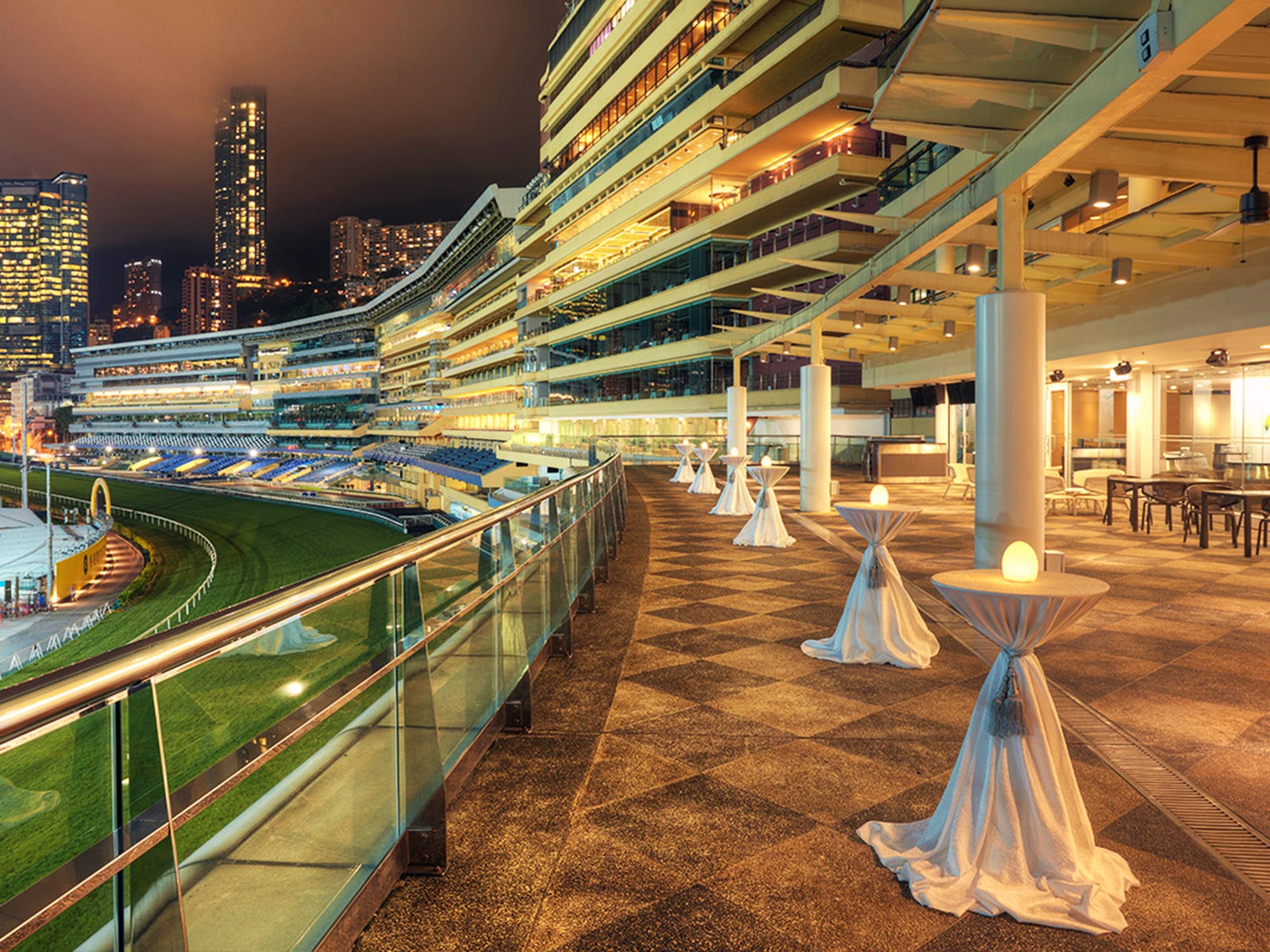
(One of the many dining areas at the Happy Valley Race Track).
According to veteran Hong Kong Jockey Club F&B director Wallace Li, any given crowd at Shatin or Happy Valley usually consists of 80 percent men and 20 percent women. They attend the races to have a good time, even if they have no interest in betting. The 380 full-time food workers and 1,000 part-time staff do their best to ensure the numerous restaurants at both venues offer menus and a variety of food that rival anywhere else in the city. And the Hong Kong public knows it.
“Over the course of a year, we typically serve 484,000 oysters, close to 100,000 bottles of wine, and 37,000 kilos of salmon,” Li says. “In one race day, we go through 383 kilos of Angus beef, 373 kilos of rice , 6,000 bottles of beer and 4,300 cups of ice cream.”
That’s not even including the two biggest race days of every year: the Chinese New Year races and the Hong Kong International Race Day in December. On those occasions, patrons will either typically go to the two high-end restaurants at each track, or the extensive moderately-priced food courts which are gaining in popularity. Hong Kong Jockey Club members have it best, with 14 restaurants to choose from in Happy Valley, and 15 in Shatin. But tourists and locals can also have a great time by either reserving a private box (prices vary), or by browsing through the food courts. Li claims that all food is recently prepared and guaranteed fresh owing to a unique “blast chilling” method used in the kitchens. It’s good enough that a question about his ultimate race night menu gets the kind of answer that shows he’s eaten his way around the track many times.
“I’d start off with a roast pork brisket as an appetizer and Osso Bucco at our Barbecue Terrace in Happy Valley. For that matter, I’d also get the homemade cheesecake there as well. I’d also advise visitors to try the soup noodles with beef brisket and the homemade soybean milk which is fresh daily at our trackside catering. Then, I’d wash all that down with an ice-cold beer.”
Pair all that with a Trio winning on a race of your choice and your night is set…
POST SCRIPT: This article was written a while ago for Where Magazine, and Way Leung didn’t quite make it into his 40s. In fact, after a dozen wins one year, his career simply drifted off. Michael Kinane retired, and is now selecting horses for the Hong Kong Jockey Club in Europe. These days, Zac Purton is still the jockey to watch. The 43 year old Australian has won the most races in Hong Kong history and continues to excel. John Size and Tony Cruz, meanwhile, are now both in their 70s and still train winning horses in Hong Kong. As for the Hong Kong Jockey Club, it had a reported revenue of nearly 44 billion Hong Kong dollars ($US5.6 billion) last year, of which, 73% was returned to the city via charities.
And on that note, it’s as good a time as any to write that I’m now being read in 23 states and 28 countries around the world. As ever, thanks for reading!