GETTING UNDER THE SKIN
Celebs and tourists alike flaunt them, but across Asia bamboo tattooing is much more than just a surface design...


(The celebrated 108-year-old bamboo tattoo artist Apo Whang-Od and her grand niece Grace Palicas, who is carrying on the tradition).
By Scott Murphy
Heading to Buscalan village in the Philippines feels like signing up for “The Amazing Race: Mountain Edition.” The journey from Manila is only around 425 kilometers. But buckle your seatbelt if you find one on those legendary packed buses, because unpredictable roads and wild transport connections turn your trip into an epic quest worthy of Indiana Jones. Half a day if luck’s with you, twenty-four hours if the universe has other plans.
But why risk all that? Adventurers do it for two big reasons: jaw-dropping rice terraces and mountains…and a shot at a bamboo tattoo from the living legend herself, Apo Whang-Od. At 108, she’s the oldest tattoo artist on the planet, a Vogue magazine cover star who rocks hip-hop threads, bold jewelry, and a queen’s swagger. Every day, hopefuls queue for a chance to get those mystical three dots—a tradition Whang-Od has perfected as the revered mambabatok of Buscalan.
(A Vogue Philippines video featuring Apo-Whang Od and Grace Palicas).
“A key thing to know about bamboo tattooing is that it involves a traditional hand-poking technique, where a bamboo stick with needles attached is used to manually puncture the skin and deposit ink, unlike modern tattoos done with electric machines,” Grace Palicas, Whang-Od’s grandniece, tells me. “The method is more culturally authentic and considered to be an artisan practice with origins in Batok traditions.”
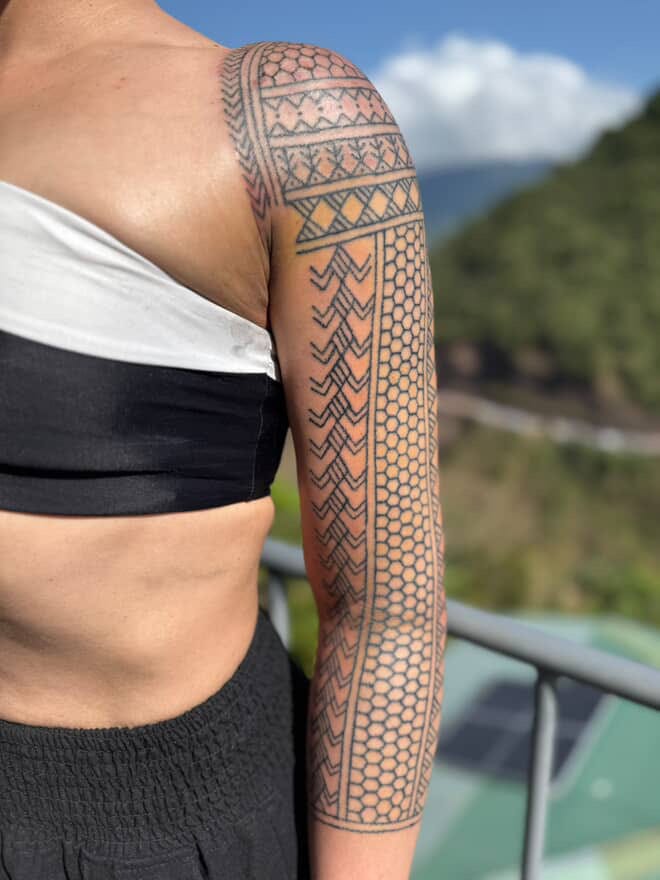
(An example of the unique tap design characteristic of tattoos in Buscalan).
Grace, at 29, spent years at Whang-Od’s side learning this 1,000-year-old craft, making sure the family’s artistic bloodline doesn’t fade. Local legend has it: if an outsider tries to learn, the tattoos go rogue—think infected, not edgy. Now Grace, along with Ilyang Wigan (another of Apo Whang-Od’s grandnieces), is keeping the tradition alive for a new tribe of tattoo lovers. While ancient warriors flaunted ink for battle or spirits, today’s tattoos pack personal stories and can get pretty intricate—elaborate geometric lines crisscrossing arms, legs, chests, and more, sometimes taking multiple sessions and days. The recipe for ink? Charcoal and water. The design, stenciled onto skin. The method, tap… tap… tap. Grace loves “fern” designs for vibes of prosperity and fertility, but also sketches mountains to channel the spirit of nature. “Tattooing is part of a bigger picture for our culture in a global way of life,” she says (palicasgrace).

(Thailand’s self-proclaimed “Bamboo Man” practicing his craft at his shop in Phuket).
Hop over to Phuket, Thailand, and you’ll find Prachitchai Daenglaoun—the self-branded “Bamboo Man”—whose studio is a temple of bamboo artistry. Decked out in his own ink, Bamboo Man works with a stainless steel bamboo stick for style meets hygiene. “I’m the best,” he jokes to me while alongside his business partner Jack Tew. Though many so-called “bamboo artists” in Thailand use machines, Bamboo Man sticks to tradition and wild imagination. “I like drawing widescreen Japanese comic characters,” he boasts. His growing fanbase is living proof that ink is universal (Bamboo Man ).

(The bamboo process as seen at Sak Yant Bangkok in Thailand).
Journey north to Bangkok: Sak Yant Bangkok takes the art further, where a steel rod called a “Khem Sak” delivers authentic Sak Yant tattoos—each hygienic, each custom-sized. Local and traveling masters (the Ajarns) offer consultations and translation, so getting inked isn’t lost in translation. Silaporn Bangbuabal, the studio’s boss, promises “a full explanation about the process and what’s going on in English,” plus picture-perfect documentation. After your session, make a pilgrimage to Wat Bang Pra temple to get your tattoo blessed—a spiritual touch no tattoo shop elsewhere can match (Sak Yant Bangkok).
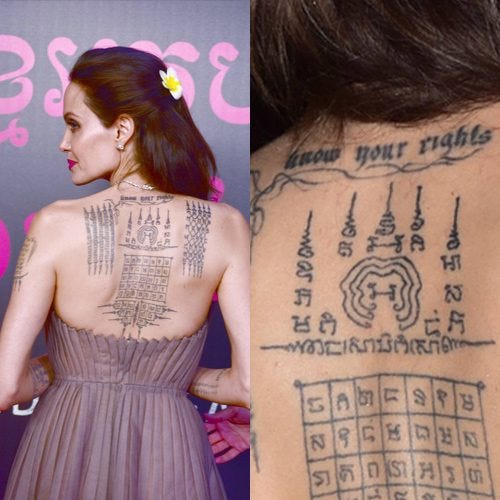
(Actress Angelina Jolie displaying several of her “Sak Yant” tattoos at a film premiere).
Talk to enough people and the roots of both hand-tapping and Sak Yants point to Cambodia. Angelina Jolie helped blast Cambodian tattoo culture into Hollywood’s spotlight, but for Cambodian artists themselves, bamboo tattooing is a serious, sacred craft with deep meaning and long apprenticeships.
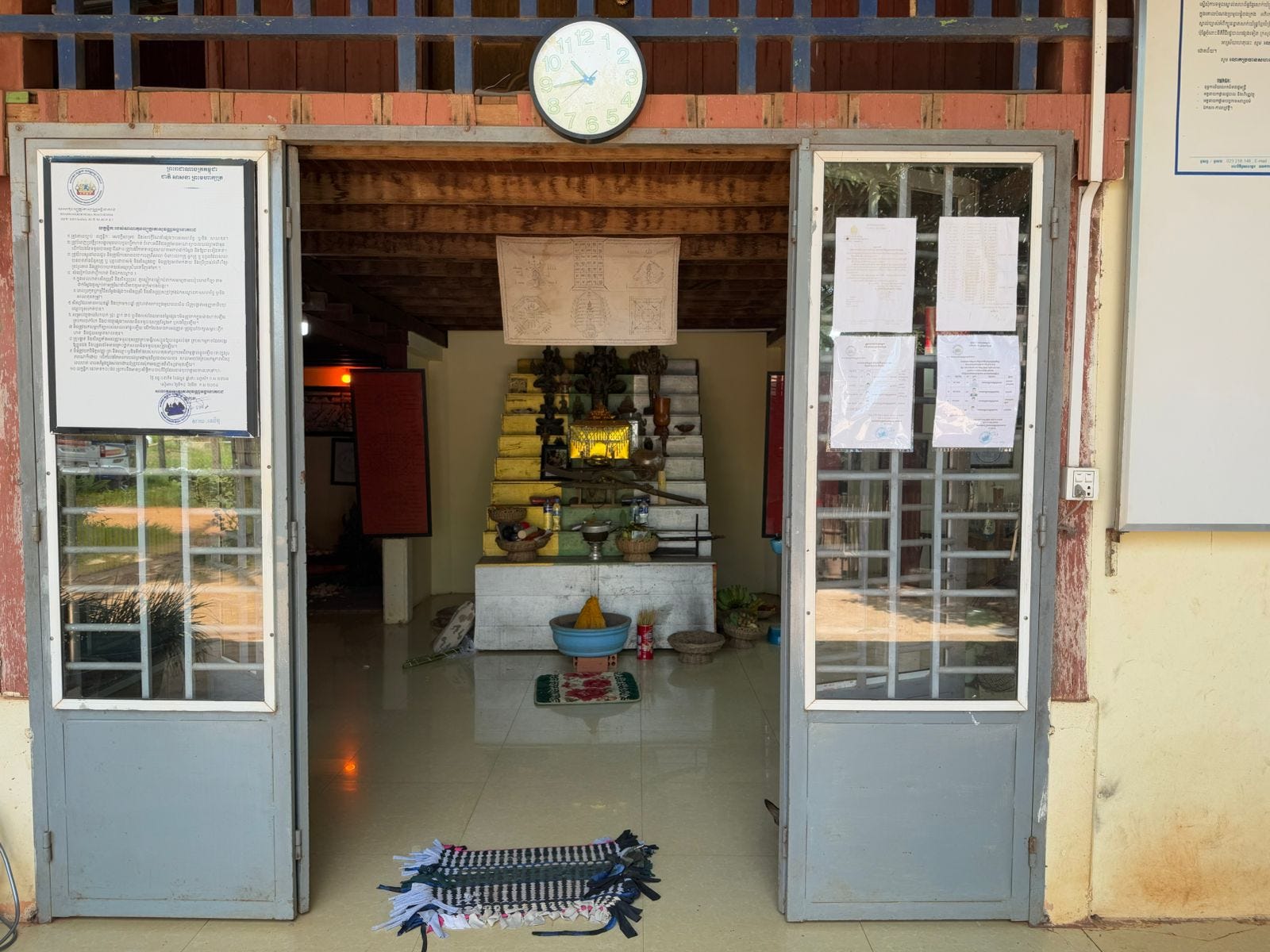
(The entrance to the Federation of Khmer Sakyantra located fifteen minutes from Siem Reap in Cambodia).
Outside Siem Reap, the Federation of Khmer Sakyantra initiative (federationofkhmersakyantra.com) is where true Cambodian bamboo magic happens. Here, SomBath Sakk and his brothers practice what their father taught: needle tips sterilized, bamboo rods, careful ink work, and spiritual blessings. “It’s generally believed that Sak Yants date back thousands of years in Cambodian culture, long before Thailand and elsewhere, though the Philippines is in its own arena in this regard,” affirms Sakk. “Sak Yants stem from the Khmer language, as ‘yants’ represent the designs and ‘sak’ means to tap or tattoo.”

(SomBath Sakk carefully creating a Cambodian Sak Yant tattoo for a visitor at the Federation).
He’s quick to note there are copycats in Phnom Penh, but those seeking genuine artistry flock to the Federation. After picking a design and receiving a thorough consultation, recipients watch careful, meaningful mantras inked onto their body, each tattoo then blessed for good luck. “We’re not only preserving our national heritage by doing this, but we are also offering special benefits to the user,” says Sakk. “Every design is carefully considered, created, and offers unique meaning and power.”
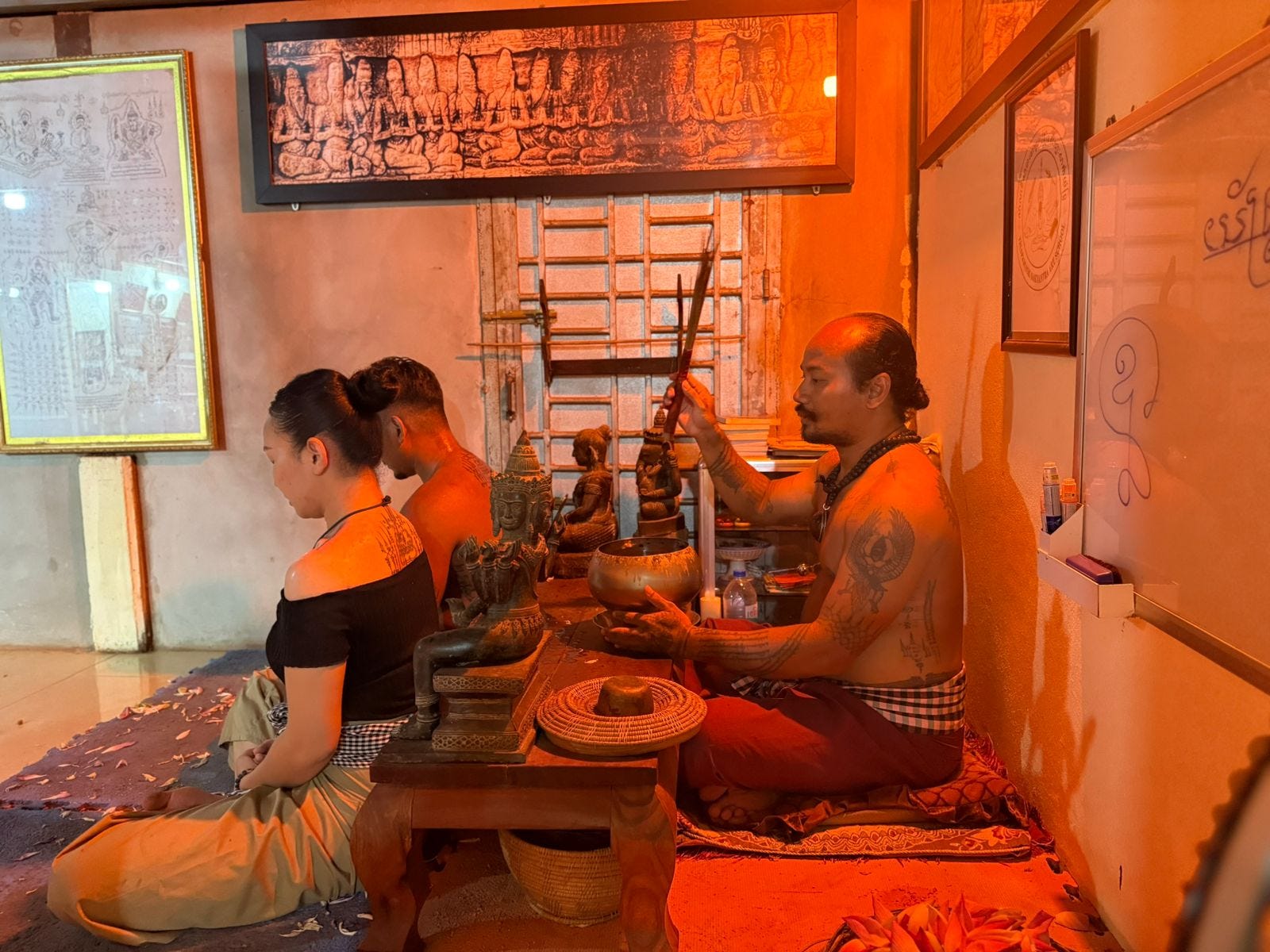
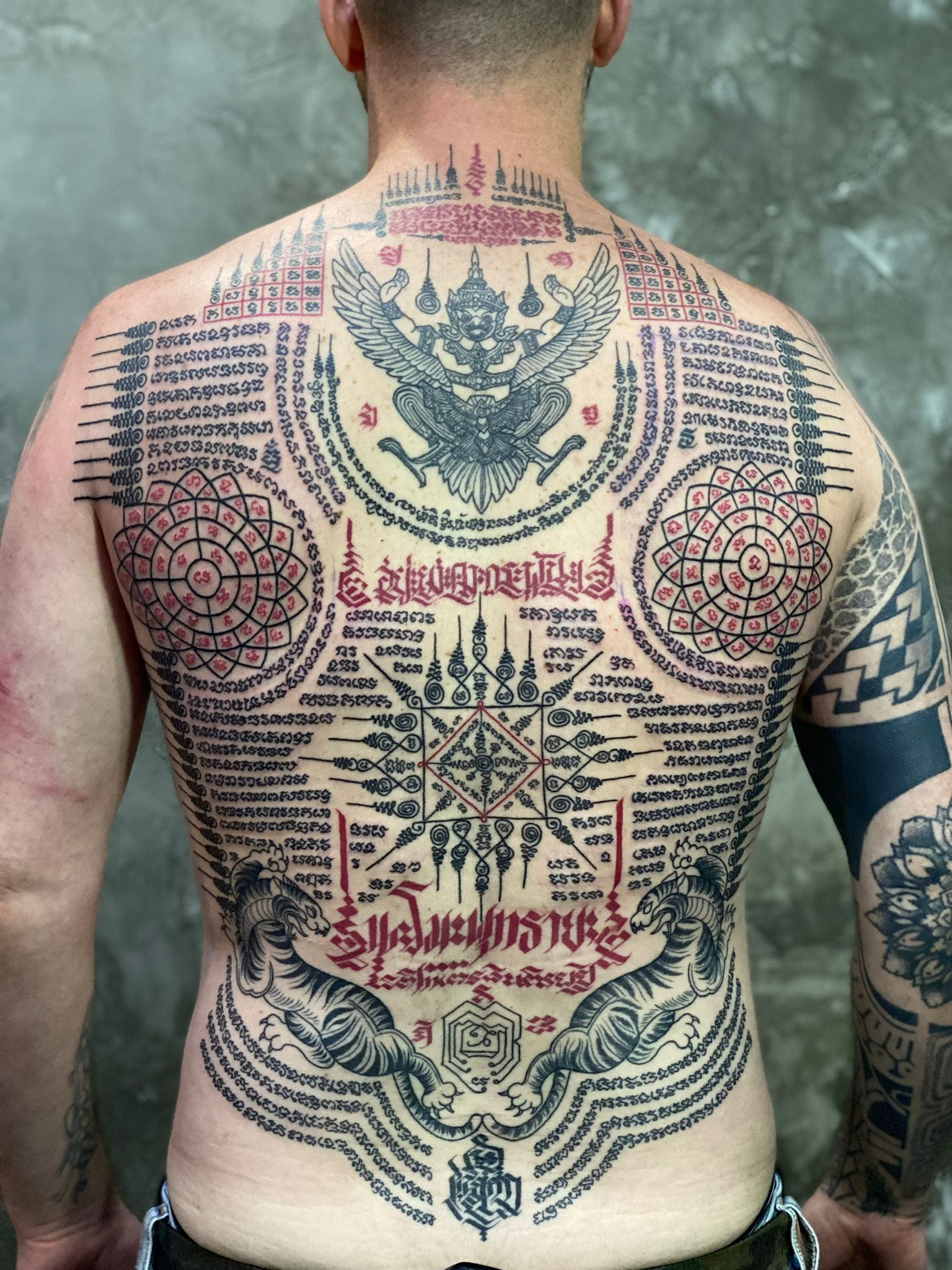
(TOP: A blessing being administered by a Master at the Federation in Cambodia. BOTTOM: An elaborate finished Cambodian Sak Yant).
(NOTE: A variation of this story is due to be published in The Verve, Auckland, New Zealand’s premiere lifestyle magazine soon…The Verve)
Very well explained the tatoo tradition in Thailand
Thanks for sharing and keep writing 💫
I have two tattoos that were done by monks at Wat Bang Phra. It's not "a spiritual touch no tattoo shop elsewhere can match." It's easy enough to go there yourself and have the tattoo done by monks and blessed in the temple. Tattooist extraordinaire Jimmy Wong brought me there the first time and translated for me. This was more than 20 years ago and I'm told the monk who did my tattoo was quite famous and that it was then blessed by the head monk of the temple. It was supposed to give me luck with women - how that turned out is debatable. There were a lot of people waiting for tattoos themselves - women in the morning, men in the afternoon, if I remember correctly. The second time I went there with my then-girlfriend, who translated for me. I had to give the monk 300 baht, a pack of cigarettes, and some incense sticks. This one meant I couldn't be shot or stabbed and so far it has worked.