OZZY OSBOURNE: AN APPRECIATION
The Prince of Darkness Goes Home...

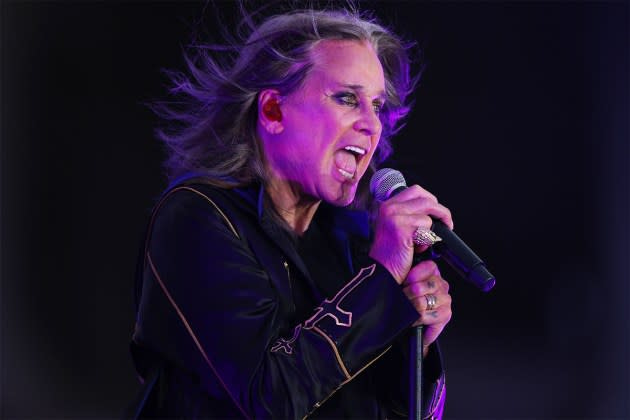
Just a little over two weeks ago, 40,000 devoted fans crammed into Villa Park, a football stadium in Birmingham, England to spend the day watching one of the greatest collection of modern hard rock acts ever assembled. For 10 hours they were spellbound by longtime veterans like Steven Tyler and Sammy Hager (still looking and sounding spry despite being in their late 70s), alongside such mega-bands as Guns ‘n’ Roses, Tool, and Metallica, in addition to young upstarts like the UK male singer Yungblud. The show was called “Back to the Beginning”, to recognize that heavy metal pioneers Black Sabbath were performing their final show just hundreds of yards from where the quartet first formed the band back in 1968. Throughout the day, many of the artists performed their rendition of well known and surprise Black Sabbath songs to an often thrilled reaction from the audience.
And then, while night fell, 76 year old singer Ozzy Osbourne, jittery and unable to walk due to his ever-worsening Parkinson’s, appeared onstage strapped to an ornate black throne. As a pay-per-view livestream was broadcast around the world (to nearly six million people), he performed five key songs from his solo career (including anthems “Crazy Train” and “Mama I’m Coming Home”). Afterwards, he was joined by his longtime Black Sabbath bandmates for four classic songs, concluding with “Paranoid”, the group’s first ever single to reach the Billboard charts. Despite pre-show rumors that he wouldn’t be able to perform, Osbourne sang with intense passion, voice often cracking, as he became increasingly invigorated by the crowd. “I just want to say on behalf of the guys in Black Sabbath, thank you for the support over the years, for you enabled us to lead the lives that we’ve led,” he said from the stage. “Thank you from the bottom of my heart.” Backstage, many, if not all, of the performers gathered for some private time and a picture with Osbourne (Osbourne even witnessed a genuine marriage proposal to his daughter Kelly). All told, an estimated 140 million pounds was raised for charity, to be split between three organizations. In terms of final shows, this may have set a new benchmark, with performers paying proper tribute while a legendary act is still around to see it.
(Ozzy Osbourne performing his 1991 solo hit “Mama, I’m Coming Home”, during one of the most emotional moments of the “Back to the Beginning” concert).
“Back to the Beginning” was a recognition of Black Sabbath’s roots in Birmingham. The four members: Osbourne (singer), Tony Iommi (guitar), Geezer Butler (bass), and Bill Ward (drums) saw music as an escape from what otherwise would have likely been a lifetime of factory work. Even then, there were doubts. Iommi lost the tips of two fingers in an industrial accident, which severely hindered his playing capabilities and forced him to create new tunings. As for Osbourne, at the age of 20 he questioned whether he could really sing or ever leave the city. “I’d convinced myself that there was no point in trying, because I was just going to fail, like I had at school, at work, and at everything else I’d ever tried,” he recalled in his autobiography “I Am Ozzy”.
For a year, they played mostly blues covers, before attempting to compose a couple songs. One day, while experimenting, they created a song that changed their lives. “Black Sabbath” was dark, plodding, menacing and genuinely scary. To complement it, they decided to name themselves Black Sabbath, after a horror movie that starred actor Boris Karloff. “When we finished the song, I kind of sunk inside myself,” Ward recently told the magazine Classic Rock. “I thought we’ve either made the most enormous mistake of our lives and completely f—-ed up our future, or we’ve opened a door that leads to something unknown.”
“What is this that stands before me?” Ozzy bellowed during the song’s opening line. “Figure in black which points at me!”
With that song — along with the rest that comprised their debut 1970 album, they practically invented a new genre — heavy metal.
(Black Sabbath performing the title track from their self titled debut album.)
Osbourne’s vocals had a uniqueness to them: though untrained, his tenor had limited range, but plenty of power. As his career progressed, double and triple tracking meant that his singing was at once distinct and inimitable. When combined with Iommi’s thick, ferocious riffs, Butler’s pulverizing bass, and Ward’s crushing drum fills, Black Sabbath paved the way for a genre of sound that is still being endlessly imitated, but can rarely be duplicated. Their follow up “Paranoid” (featuring the title track which became their biggest ever hit) was released in the same year as their debut. Six more albums with the original band followed — all dropped within a year or two of each other — and all building on a powerful, riff-heavy sludge-like sound which became their trademark. Critics were largely dismissive, but with each multi-platinum release their fan base grew. And so did their range, as the group flirted with any number of influences that they could incorporate into their songs (Osbourne, for example, was a devout Beatles disciple).
(Black Sabbath performing “Snowblind” live in 1975, an obvious ode to their growing love of cocaine).
Behind the scenes though, Sabbath’s growing success was coming at a cost. On the one hand they were able to afford lengthy recording times in more glamorous locales like Miami and Los Angeles. But their intense schedules, combined with their addictive personalities and pleasure seeking ways, meant that the group was increasingly turning to alcohol and drugs as a way to blow off steam. “We’d rented a house in Bel Air,” recalled Osbourne during a 2021 interview with NME. “I’m sitting in the f—-ing house and I’ve got a big f—-ing bowl of cocaine on the f—-ing table. I was sitting there thinking, ‘It’s f—-ing boiling in here.’ So I press a button on the wall, thinking it’s air conditioning. 10 minutes later six cop cars come screaming down the driveway. It’s the Bel Air patrol.” Thinking it’s a raid, Osbourne shoveled piles of the drug into his nostrils. As it turned out, it was a false alarm. “I couldn’t feel anything,” he recalls. “My nose was caked in it. I had to have a f—-ing valium after to mellow me out.”
Over the course of their original eight album run, substance abuse affected all members at various points, but it debatably affected Osbourne the most. During the late 70s, he quit, before returning to the band, after which they asked him to leave permanently. “I honestly thought I’d have to go back to the UK and work on a building site or something,” Osbourne said in his memoir. “I just resigned myself to the fact that it was over.” For months, he drank and consumed drugs in a Los Angeles hotel, but new manager Sharon Arden had other plans. In quick succession, she hired musicians — including a young guitar prodigy named Randy Rhoads — and the group recorded an album, which became Osbourne’s first solo release “Blizzard of Oz”.
(Ozzy Osbourne performing single “Crazy Train” live in 1981 alongside guitarist Randy Rhoads).
“Blizzard of Oz” became one of the top 100 selling albums of the decade, meaning that Osbourne could survive on his own without Black Sabbath, who were thriving with new singer Ronnie James Dio. But Ozzy being Ozzy, it’s what happened next over the ensuing years that made him such a formidable, eccentric, and legendary music figure. Here are just a few incidents (of many):
Following a divorce from his first wife, Osbourne married Sharon, a partnership that survived breakups, infidelities, police incidents, and more until today.
After signing his solo record deal, an intoxicated Osbourne bit the heads off two doves that were presented to him as part of the celebration.
Thinking it was fake, Osbourne bit the head off a dead bat that was tossed to him while he was performing live in Des Moines, Iowa.
A plane piloted by Osbourne’s driver clipped their tour bus and crashed, killing all occupants, including the group’s makeup designer and guitarist Randy Rhoads. Osbourne was asleep in the bus at the time.
While wearing his wife’s wedding dress, Osbourne was arrested after getting inebriated and peeing on the Alamo, a revered historic site in San Antonio, Texas. He was subsequently banned from the site for a decade.
Osbourne snorted a row of ants on a dare before fellow tour mates Motley Crue.
Osbourne performed at Live Aid before a television audience of millions with a reunited Black Sabbath (the group would break up and reunite several times over the next few decades, and even recorded a studio album in 2013, called “13”, which won a Grammy Award).
Osbourne performed before Queen Elizabeth at Buckingham Palace.
Osbourne crashed an ATV vehicle at his home in England, which left him with cracked vertebrae, eight broken ribs, a broken collarbone, and put him in a coma for eight days.
Osbourne went for rehab at the Betty Ford Clinic in California, thinking he would learn the art of how to drink like a gentleman.
(Osbourne talking to radio talk show host Howard Stern in 1996 about his stint in rehab).
While Osbourne’s musical career went from strength to strength — the 1991 album “No More Tears” was cited as a critical highpoint (even winning a Grammy) — it was a seemingly innocuous 1989 film clip in the documentary “Decline of Western Civilization II - The Metal Years”, which eventually led to a new facet of Osbourne’s career as a reality TV star. In the scene, Osbourne is casually discussing the perils of a rock and roll career while making breakfast. Only, he’s completely oblivious to the fact that he’s spilling orange juice all over the place.
Two decades later, this and other public appearances by Osbourne led MTV producers to create a reality TV show around the family, called “The Osbournes”. It became the most watched show ever on the channel, ran for four seasons, and even won an Emmy Award. It also led to several spinoff reality shows, including “Ozzy and Jack’s World Detour”, a program featuring Osbourne and his son. Ozzy later claimed he was stoned during the entire filming of the initial series, but by then, the family’s fame reached well beyond music fans.
(In this scene from the TV reality show “The Osbournes”, the family try to deal with noisy neighbors in Los Angeles, with hilarious results).
Osbourne’s natural gait was always a bit awkward, and at the urging of wife Sharon, he went for a genome test in 2003. The test revealed that he had the PARK2 gene, a sign of Parkinson’s, which largely lies dormant unless it’s affected by stress. Well stress certainly came a calling. The aftermath of the ATV crash, combined with a bed fall against a metal pole in 2019, meant that Osbourne’s 70-something body was handling more hardship than it could take. A botched 2019 surgery was partially corrected by a follow-up in 2021, yet other illnesses, an emphysema diagnosis, the COVID epidemic, and his worsening Parkinson’s condition meant that he couldn’t endure a final tour. A one-off was the best he could hope for.
(During this 2023 interview with host Graham Bensinger, Ozzy and wife Sharon detail how his ambition to perform has been derailed by his continued health struggles).
Over the last few years, Osbourne did manage to release two well received studio albums, which featured a slew of special guests, proving that his vocals were still in fine form despite his physical hardships. And then came the final show, which, by all accounts, was a triumphant performance.
Whether Osbourne knew the end was truly near, only he and his family know, but a little over two weeks after the performance, an emergency medical helicopter was called to his UK home, to no avail. Osbourne leaves behind six children, 10 grandkids, his wife Sharon, 13 studio albums (and nine more with Black Sabbath), 5 Grammy Awards, an induction into the Rock and Roll Hall of Fame, a star on the Hollywood Walk of Fame, a slew of lifetime achievement awards, and songs covered by millions of multi-generational fans around the world. “There was no Ozzy before Ozzy,” said KISS frontman Gene Simmons upon learning of his death. “He was a complete original.”
(The young Louisville Leopard Percussionists from Kentucky performing “Crazy Train”, one of Osbourne’s biggest hits, before Ozzy and family in 2019).
Good piece.