
THE TRAILBLAZER
Talking to former MTV CEO Tom Freston about his global travels and visionary career...

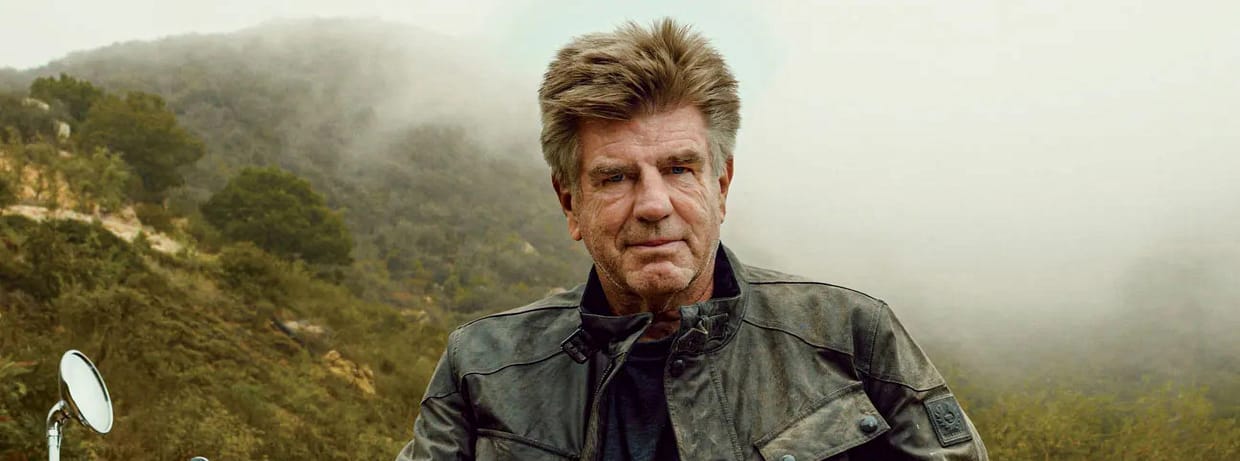
Tom Freston spends his life arriving at the edge of things just before they become inevitable. In the 1970s, he was in India and Afghanistan learning how to build a business from almost nothing. During the early MTV years, when cable still felt provisional and new, he helped define the visual grammar of a generation. By the 1990s and early 2000s, when Viacom became a media empire and digital disruption stopped looking hypothetical, he was inside the machinery itself, meeting a young Mark Zuckerberg and watching the old order begin to loosen. “I was making it up as I went along,” he tells me while sitting amidst his spectacular library in his tasteful Santa Barbara home, and that may be the truest summary of his career. It also explains why he keeps calling himself, with disarming modesty, “humble.”
He is the rare media executive who sounds like he has actually lived in the places that shape him. “I think everybody should experience foreign places,” he says. “For example, I think a lot of the animosity towards China would go away if they were there.” That restlessness runs through everything he does. As he vividly details in his new autobiography “Unplugged”, the now 80 year old did not become interesting by staying put. He became interesting by moving through the world and paying attention. “If you don’t know really where you are, you start noticing things,” he says, and that is as close as he comes to a philosophy.
After traveling across Europe and Africa in the 1970s, he veered away from the expected path and into Asia, where he tried to make a life in the clothing business with little more than nerve and instinct. “There wasn’t a lot of other people doing it,” he says. “I saw that there were trends that were emerging…and I thought I could learn it on the run.” The phrase is pure Freston: practical, unsentimental, slightly improvised. He is never trying to look like an expert. He is always trying to become one.
Afghanistan and India became the great proving grounds. “The hardest thing was learning how to function in those two countries at that particular point in history,” he says. “Very tumultuous, very unsophisticated. No telephones, no nothing really.” It was, he says, “the hardest work I turned out that I would ever do.” But it is also where his appetite for the unfamiliar sharpened. “I’ve always been a sucker for what I consider the exotic,” he says.
Though Hindu Kush, his clothing business, made millions, he saw the writing on the wall by the late 1970s, and joined Warner-Amex Satellite Entertainment Company. While there, he became part of a small team that launched MTV. They struggled at first, but once this head of marketing created the “I Want My MTV” ad campaign with Mick Jagger, David Bowie, Paul McCartney, and more, they were off and running. The network was, in his telling, “an eccentric, left-of-center media organization filled with untraditional people.” He was not there to dominate it; he was there to work with it. “I wasn’t an egomaniac,” he says. “I tried to be as culturally fluent as I could, as a novice.” That humility was not decorative. It was operational. He learned fast because the environment required it.
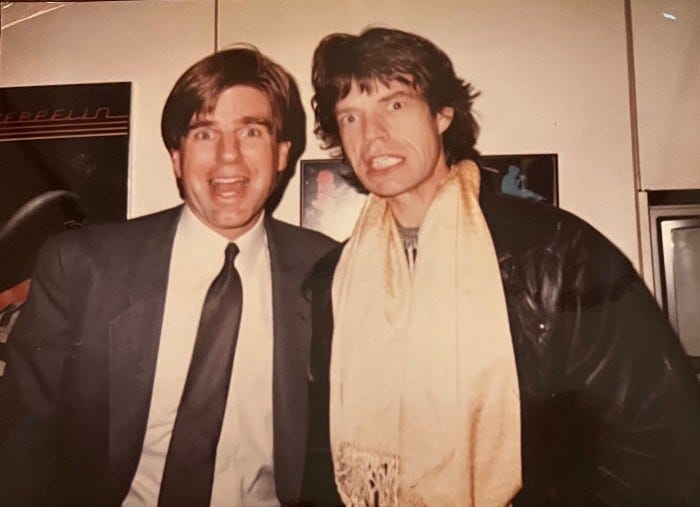
(Tom Freston with Mick Jagger of The Rolling Stones during the early 1980s).
Within a few years, MTV expanded from a single cable channel into something bigger and more unruly. “Every couple years, it was like a different kind of company,” he says. One year it was cable, the next international, then movies, then animation. “I was running a different type of company, a different series of different kind of companies.” Freston’s gift is not just that he adapted to change. It is that he seemed to expect it.
He admits to a certain amount of impostor syndrome, and that only made him more watchful. “I used to think, I hope people don’t realize, I don’t know what the hell I’m doing,” he says with a grin. But the uncertainty sharpened his discipline. It made him ask questions, observe more carefully, and accept that most serious jobs are partly learned in motion. In a culture that rewards certainty, he remained persuasive because he never pretended to know everything.
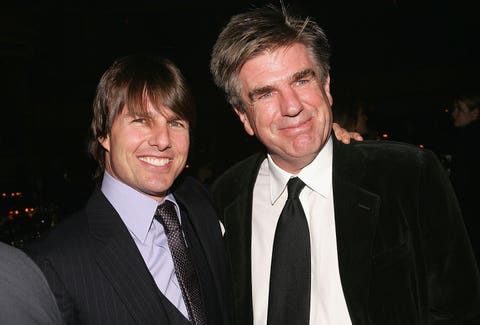
By the 1990s and early 2000s, during the Viacom years, he was operating at the center of the media business’s most glamorous and punishing pressures. “I was never frightened, but I was never totally comfortable,” he says. “When you get into the movie business, you’re really taking big risks.” He understood the scale of the bets and the limits of his own control. “You’ve got to put on your big boy pants,” he says, with characteristic dryness.
His eventual firing by CEO Sumner Redstone at his Los Angeles house arrived swiftly, abruptly, and in a way that feels almost theatrical. “I just got up and walked out,” he says. “I never said goodbye.” Even then, he had seen it coming. “I knew it was going to happen,” he says, with the calm of a man who has long since converted disappointment into perspective. “It turned out to be a blessing,” he adds. “They fired me at exactly the right time.”
When the digital era began to redraw the map, he recognized the shift before most of the old institutions did. “We knew the game was changing,” he says. “This was a whole new paradigm.” Facebook, YouTube, MySpace — these were not curiosities to him but evidence of a world where the gatekeepers were losing their grip. “Could I have imagined that YouTube would… ultimately be worth 800 billion?” he asks. “No. But we knew this was the future.”
His philanthropy follows the same logic: find the pressure point, then keep pressing. With (RED) and the ONE Campaign, tackles global health and poverty with the same instinct for scale that guided his media career. “It started out, you know, give us, buy this product,” he says, but the real point is bigger than branding. “We’ve raised close to 900 million dollars,” he says. “Twenty-five million people are walking around alive now who would’ve been dead without these drugs.”
He remains plainspoken about the politics around that work. “President Trump blew a big hole in the global health ecosystem,” he says. Yet he keeps returning to the same practical question: where does agency live now, and how can it be expanded? “African countries are saying, you know what, we want to be able to finance some of this stuff ourselves,” he says. “They want more investment.” That is the tone he prefers: direct, unsentimental, forward-looking.
What links the 1970s, the MTV explosion, the Viacom years, the digital upheaval, and his global health work is not a single industry or even a single talent. It is a temperament. “We were on an exciting career trying to make something out of our wits,” he says, describing his early days working with TOLO TV in Afghanistan starting in 2007. The line could apply just as easily to Asia in the seventies, MTV in the eighties, or the internet age in the 2000s. Freston is always drawn to places where the future is only half-visible.
Even now, he still sounds like someone who prefers first encounters to settled arrangements. Asked whether he prefers the India of the past or the India of the present, he answers immediately: “I prefer the India of the past.” Not because he resists change, but because he understands the charge of discovery. He misses the feeling of being inside a world as it is still taking shape.
That is the Tom Freston story: not a monument, but a moving target. He kept finding the front edge before the rest of the room named it. He learned by immersion, managed by improvisation, and treated uncertainty not as a flaw in the system but as the system itself. That is why the story keeps moving. That is why he does too. “I learned on the fly,” he says about much of his career. “As did most of my colleagues! I mean who the hell knew how to make a movie!”